Sunday, November 1, 2015

Creative Cultures of Innovation

Introduction
One of the biggest buzzwords in today’s business world is innovation. We hear how different companies claim to be centers of innovation and are pushing the limits of creativity. From a marketing perspective, it is a great way to sell your company as having a culture that inspires and accepts new ways of thinking. Ed Catmull, CEO of Pixar, is quoted in saying, “Managers scour books and magazines looking for greater understanding but settle instead for adopting a new terminology, thinking that using fresh words will bring them closer to their goals… To ensure quality, excellence must be an earned word, attributed by others to us, not proclaimed by us about ourselves.” Pixar is a recognized leader in creating widely admired stories with both inventive plotlines and emotional authenticity. IDEO is another award-winning firm that focuses on human-centered design to help organizations innovate and grow. In a case study comparing these companies, we will discuss leadership approaches that support a creative culture, benefits of project limits, appropriate team dynamics, value of experimentation, and a strong mission focus.

Historical Theories

Over the last few years the debate on whether or not lone inventors are the source of breakthroughs has continued to evolve. The idea generation process goes through three basic phases: variation, selection, and retention. Data suggests that although individuals can’t typically recognize the difference between good and bad ideas as well as groups, a group that generates ideas together won’t produce as much variety. Hybrid teams that start as individuals and then come together for the last two phases have better average quality of ideas, quantity of ideas, and variance of ideas.

Team dynamics also play a factor with the greater the diversity in a team, the more creative the results. Varied backgrounds of individuals will increase the collective knowledge of the group and allow for connections to be made across divisions of individual expertise. One theory is that ideas and knowledge exist because of the individuals whom make the necessary mental connections. Resulting from this hypothesis, the importance of individual talent is key to an organization’s success. One study suggested that approximately 5% of all the employees in an organization create more than 50% of all the new ideas for a firm. In fact, who is leaving or joining the firm determines the culture which attracts, selects, and causes other people to remain in the firm. The key takeaway is that talent is the most important asset or resource a firm can acquire and cultivate.

Leadership and Culture
One traditional framework for leadership in a business is where the company hierarchy establishes a vision for the future plans and growth of the organization and then works to inspire others to execute that plan. Creative leadership is fundamentally different. Following Disney Animation’s purchase of Pixar, one of the managers came to Ed Catmull with a two-year plan that laid out exactly how she was going to manage her department moving forward. He responded by telling her she had narrowed her thinking and that chances were that they would end up somewhere other than where she had planned (see below).


“Instead of setting forth a ‘perfect’ route to achieving future goals (and sticking to it unwaveringly), I wanted [managers] to be open to readjusting along the way, to remaining flexible, to accepting that we would be making it up as we go.” Leaders have to create space or an environment for innovation, a place where people want to belong and interact. This environment is both a spatial and social atmosphere where experimentation is common. Leaders need to be aggregators of conflicting viewpoints who empower the voices of all their employees. It is better to be fuzzy and vague at the top than giving answers and solutions. You want to be able to encourage ideas from those within your organization that interact with the customer and have an environment where those ideas are tested with candid feedback from your entire team. In my conversation with Ed Catmull, he said, “Hierarchy is there but communication is separate.” Teams are created for problem-solving. The feedback they receive is to communicate ideas and identify problems but decisions come from within the team. Management’s role is to help build teams, find talent, help teams fulfill their role and help others see conflict as healthy.

Benefits of Project Limits


There are many ways that conflict is healthy for a creative culture. Unless a company is willing to attempt to do something that might fail, they aren’t pushing themselves enough. Fail early and fail often. By encouraging risk and pushing the limits, people are forced to improvise and create unexpected solutions for unexpected problems. IDEO and Pixar both empower their employees to act and solve their own problems as they find them. When Pixar and Disney combined, Ed Catmull and John Lasseter decided that Disney needed to create its own culture and they would not share resources between the two studios. Limits forced groups to find creative solutions when time was short or they were having issues rendering a particular effect for a film. Limits imply that you can’t do everything you want so you must think of smarter ways to work and think. Balance is inherently required when working within constraints.


IDEO specifically begins their design process by evaluating ideas with three overlapping constraints in mind: feasibility (what is functionally possible within the foreseeable future); viability (what is likely to become part of a sustainable business model); and desirability (what makes sense to people and for people)Design thinkers will work to bring these constraints into balance; however, not all constraints are created equal. Some projects are driven by technology, budget, or a mix of different human factors. An organization may focus on one factor or another. There isn’t a linear approach to balancing constraints but all of them should be considered during the life of a project.

“Most companies will start with the constraint of what will fit within the framework of the existing business model. Because business systems are designed for efficiency, new ideas will tend to be incremental, predictable, and all too easy for the competition to emulate…. A second approach is the one commonly taken by engineering-driven companies looking for a technological breakthrough. In this scenario teams of researchers will discover a new way of doing something and only afterward will they think about how the technology might fit into an existing business system and create value…. Relatively few technical innovations bring an immediate economic benefit that will justify the investments of time and resources they require.
IDEO has found that innovation comes from balancing these constraints through human-centered design. Focusing on one element of the triad may undermine the sustainability of the overall program.

Team Dynamics

A common best practice is to hire smarter talented people to be the source of creativity. Pixar expands this belief by saying “Give a good idea to a mediocre team and they will screw it up. Give a mediocre idea to a great team and they’ll either fix it or come up with something even better.” The secret, mentioned before when discussing leadership, is to focus on having the right chemistry with the right team than having the right idea. Teams focus on collective genius and not individual breakthroughs in an additive, evolving, and collaborative process. IDEO describes their smart teams as a team of teams. Each team member has strengths in two dimensions – a tangible and valuable expertise that is hard to acquire and the disposition for collaboration across disciplines. A smart team is an interdisciplinary team where “there is a collective ownership of ideas and everybody takes responsibility for them.” Pixar also subscribes to the value of cross-functional learning and collaboration. At Pixar, employees have classroom experiences and interactions where everyone can learn more about other roles in the company. These new situations taught them to be more comfortable making mistakes and to see new ways in which they could improve and change their processes they were teaching to each other.

The greatest learning opportunities at Pixar happen at Braintrust meetings. The sole purpose of Braintrust meetings is to focus on problem-solving with the film currently in development and not some personal agenda. Arguments, even heated ones, are always about the project. The film is under the microscope and not the director and his team. Everyone involved is seen as a peer and are encouraged to voice their opinions candidly. They talk about what is working and what isn’t. They make suggestions, provide feedback, and continue to rework and rework a character until the iterative process finally helps it find its soul. The one thing that the Braintrust does not have is the authority to make final decisions on the story. The director of the film always determines the path moving forward and does not have to follow any suggestions that are given in the meeting, regardless of who made them. Although the Braintrust is made up of individuals who are expert storytellers and have been through the process themselves, Pixar believes that any solution presented won’t be as good as the one the director and his or her creative team can come up with. It is this environment of candor and trust and a focus on ensuring that all voices are given equal weight that make Braintrust meetings what they are.

IDEO uses Post-it notes to measure the weight and value of an idea with what they call the “butterfly test.” After lots of research and observation and numerous brainstorming and prototyping sessions, a whole wall is covered with promising ideas. Then each participant is given a small stack of Post-it “ballots” to attach to ideas that they think should move forward. Not long after everyone has gone fluttering around the room, it is clear which ideas have attracted the most “butterflies.” Then begins a debate and a consensus is eventually reached. “The process is not about

democracy, it is about maximizing the capacities of teams to converge on the best solutions.” Certain approaches are important for making choices, but good brainstorming sessions create choices and is the route to innovation.
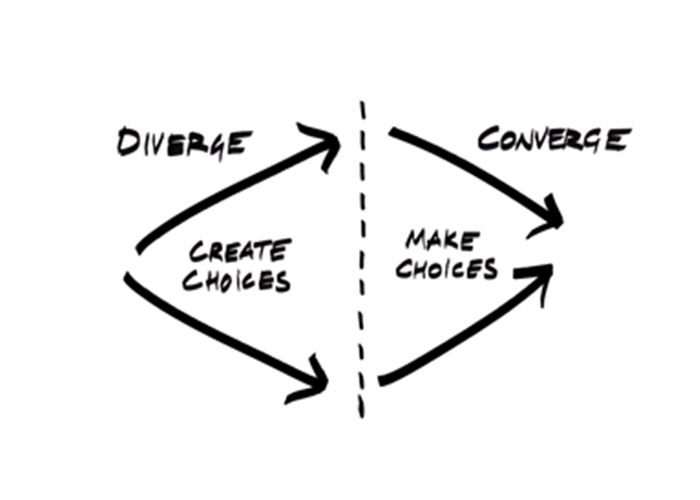
“At IDEO we have dedicated rooms for our brainstorming sessions, and the rules are literally written on the walls: Defer judgment. Encourage wild ideas. Stay focused on the topic. The most important of them, I would argue is ‘Build on the ideas of others.’… It ensures that every participant is invested in the last idea put forward and has the chance to move it along.” Design-thinking is a balance between the divergent and convergent process as well as the analytical and synthetic processes.

Converging is to drive toward a solution, while diverging is to multiply options to create choices. When we analyze complex problems, we break them apart to understand them better. The creative process of synthesis extracts and identifies meaningful patterns from the data. It helps create the narrative or the story which drives the project. “People have to believe that it is within their power (or at least the power of their team) to create new ideas, that will serve unmet needs, and that will have a positive impact.” This confidence is built on trust and trust flows both ways. IDEO builds trust between their designers and their clients by sharing the creative experience. Their team of experts sometimes consists of a small “unfocus” group of eight-to-ten-year-olds, depending on who the end customers are. The purpose is always human-centered design.

Experimentation

Designing for innovation moves through stages of inspiration, ideation, and implementation. With IDEO’s strong belief of thinking with their hands, design thinkers can test and refine a portfolio of ideas through series of experiments, not pilots. Testing how something looks through visualizing it in a picture, role-playing a scenario, or a prototype forces a designer to make immediate decisions on how a customer will interact with a service or use a product. The different stages of innovation can be observed as these experiments become more polished and refined. During the early stages, prototypes are quick, dirty, and cheap, with many being made in parallel with one another. The greater the investment in an idea, the more committed one becomes to it. As the process progresses, each iteration decreases in quantity and increases in quality.  IDEO designs for the entire customer experience, which they call the 4th dimension. By mapping out the sequence of the overall customer journey, they identify key emotional touchpoints, turn them into opportunities and build upon them, in sequential order, across time. They can then test if the central narrative of their designed experience is meeting the needs of the customer in a powerful way.

One of the key things they do during ideation is observation. They literally put themselves in the place of the end user. When designing for emergency rooms, they literally feign an injury, call an ambulance, and go through all the steps a patient will, so that they can notice all the details and feelings a patient would. Then they observe analogous situations like a driver going to a pit crew or weary traveler checking into a hotel. They want the higher level of acuity when nothing is familiar because nothing is routine. They want to know what to do and what not to do. They want to understand what to say and what not to say. They are going on what Pixar calls “research trips.” They are looking for authenticity in their storytelling.

The first guiding principles of Pixar was “Story is King.” This meant that nothing gets in the way of the story and how it makes people feel. Whether it was a Braintrust meeting or a Daily, the Pixar differentiator is that this mantra isn’t just said but it is believed and acted on as the main focus of every storyboarding process. Dailies make directors present incomplete work to their colleagues to get constructive midstream feedback. It is in essence the Pixar prototype. Another experimental arena to test a team’s ability is through shorts. They consider shorts – three- to six-minute films that begin a feature film – to be a justified expense as R&D where they improve technically, like rendering clothes on human characters. Pixar and IDEO excel because they experiment and with each iteration, improve with each success and each mistake.

Strong Mission Focus

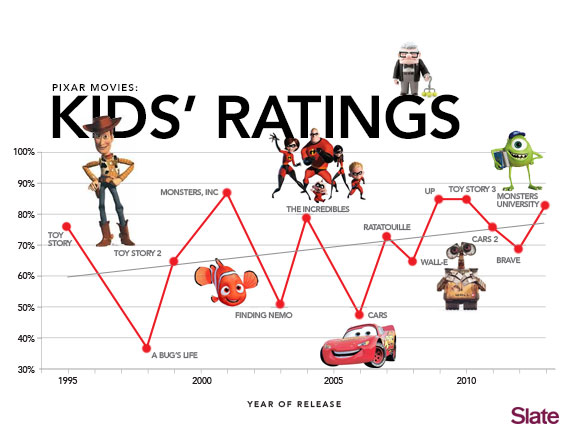
Pixar and IDEO both focus on really the same thing – quality of the human experience. Pixar is the master of storytelling. The reason they are such experts is because they value learning and quality. At the end of every movie, they hold a meeting called a postmortem where they explore what didn’t work and attempt to consolidate what they learned. “Everyone was so engaged in rethinking the way we did things, so open to challenging long-held ideas and learning from the errors we made. No one was defensive.” They not only were proud of sharing what they had accomplished and teaching others who weren’t a part of the film, but they had to reflect and prepare for the discussion. They are able to prepare for future films and future problems because they are already asking the right kinds of questions.
Year of Release Year of Release

One of the key problems that Pixar was able to identify early was how success could affect their culture. This is where the concepts of “Feed the Beast” and “Ugly Babies” come from. The first concept is one where success leads to a demand for more success and a need for increased output and speed. The second idea describes how new ideas may be ungainly and poorly defined but are the opposite of established and entrenched ideas. New ideas take time to cultivate and rework until they become something truly amazing. They didn’t want schedule to drive their output, but the strength of the ideas at the front end. There is a balance to obtain that kind of quality storytelling between these two inherent forces.

IDEAO, as mentioned before, tries to understand feelings and experiences so the products and services they create meet latent needs and emotions. The mission of IDEO is to center all design on people. To measure the balance of their innovation efforts, they created the "ways to Grow" matrix.

 
Like Pixar, IDEO believes that repeating old plans will create incremental innovation through extending a successful brand or the next iteration of a current product. Evolutionary products come by "extending existing offerings to solve the unmet needs of current customers or adapting them to meet the needs of new customers or markets." These needs and markets are found in the tails of the normal bell curve of a company's market research. The outlying populations can teach us new things abut creativity from their passion, their knowledge, or simply the extremity of their circumstances. This leads to revolutionary innovation where you are creating new markets. IDEO's philosophy is that "a company's best defense is to diversify its portfolio by investing across all four quadrants of the innovation matrix."

Conclusion

Although Pixar and IDEO come from very different industries, they are examples that you can't have "too much" talent in terms of creativity and innovation if it's part of the company culture. Innovation is messy and there needs to be a space and an environment where conflicting viewpoints can be shared and ideas built. Interdisciplinary teams need candid communication and focused on problem-solving. Innovation is a process with mistakes and because it is new, but there is also trust that the teams involved will be successful in finding solutions for those problems. Innovation requires a balance of the limits and pressures from success. Lastly, any product requires a process or service for it to be used and that user experience should be designed (as the quality product or service itself) with the needs and emotions of the customer in mind. Creativity and innovation are not talents only for the select few but they are results from skills we can all develop and contribute, in the right environment and as part of the right kind of team.

Friday, October 2, 2015

The Advocate

I like taking personality tests. Some I have found to be more accurate than others. The Myers-Briggs Type Indicator (MBTI) is one that is more on the less accurate side because your results can change. In fact, they can change frequently. Still, I took it recently because I wanted to get a better gauge at where I am at emotionally and mentally. I figured I could use a small snapshot. There are 16 different combinations from 4 pairs of traits. There is introversion (I) or extraversion (E), intuition (N) or sensing (S), thinking (T) or feeling (F), and judging (J) or perceiving (P). My result was as follows:

INFJ Personality


The INFJ personality type is very rare, making up less than 1% of the population, but they nonetheless leave their mark on the world. As Diplomats (NF), they have an inborn sense of idealism and morality, but what sets them apart is the accompanying Judging trait - INFJs are not idle dreamers, but people capable of taking concrete steps to realize their goals and make a lasting positive impact.
INFJs tend to see helping others as their purpose in life, but while people with this personality type can be found engaging rescue efforts and doing charity work, their real passion is to get to the heart of the issue so that people need not be rescued at all.

Help Me Help You


INFJs indeed share a very unique combination of traits: thought soft-spoken, they have very strong opinions and will fight tirelessly for an idea they believe in. They are decisive and strong-willed, but will rarely use that energy for personal gain - INFJs will act with creativity, imagination, conviction and sensitivity not to create advantage, but to create balance. Egalitarianism and karma are very attractive ideas to INFJs, and they tend to believe that nothing would help the world so much as using love and compassion to soften the hearts of tyrants.

INFJs find it easy to make connections with others, and have a talent for warm, sensitive language, speaking in human terms, rather than with pure logic and fact. It makes sense that their friends and colleagues will come to think of them as quiet Extroverted types, but they would all do well to remember that INFJs need time alone to decompress and recharge, and to not become too alarmed when they suddenly withdraw. INFJs take great care of other's feelings, and they expect the favor to be returned - sometimes that means giving them the space they need for a few days.

Live to Fight Another Day


Really though, it is most important for INFJs to remember to take care of themselves. The passion of their convictions is perfectly capable of carrying them past their breaking point and if their zeal gets out of hand, they can find themselves exhausted, unhealthy and stressed. This becomes especially apparent when INFJs find themselves up against conflict and criticism - their sensitivity forces them to do everything they can to evade these seemingly personal attacks, but when the circumstances are unavoidable, they can fight back in highly irrational, unhelpful ways.

To INFJs, the world is a place full of inequity - but it doesn't have to be. No other personality type is better suited to create a movement to right a wrong, no matter how big or small. INFJs just need to remember that while they're busy taking care of the world, they need to take care of themselves, too.

INFJ Strengths


  • Creative - Combining a vivid imagination with a strong sense of compassion, INFJs use their creativity to resolve not technical challenges, but human ones. People with the INFJ personality type enjoy finding the perfect solution for someone they care about, and this strength makes them excellent counselors and advisors.
  • Insightful - Seeing through dishonesty and disingenuous motives, INFJs step past manipulation and sales tactics and into a more honest discussion. INFJs see how people and events are connected, and are able to use that insight to get to the heart of the matter.
  • Inspiring and Convincing - Speaking in human terms, not technical, INFJs have a fluid, inspirational writing style that appeals to the inner idealist in their audience. INFJs can even be astonishingly good orators, speaking with warmth and passion, if they are proud of what they are speaking for.
  • Decisive - Their creativity, insight and inspiration are able to have a real impact on the world, as INFJs are able to follow through on their ideas with conviction, willpower, and the planning necessary to see complex projects through to the end. INFJs don't just see the way things out to be, they act on those insights.
  • Determined and Passionate - When INFJs come to believe that something is important, they pursue that goal with a conviction and energy that can catch even their friends and loved ones off guard. INFJs will rock the boat if they have to, something not everyone likes to see, but their passion for their chosen cause is an inseparable part of their personality.
  • Altruistic - These strengths are used for good. INFJs have strong beliefs and take the actions that they do not because they are trying to advance themselves, but because they are trying to advance an idea that they truly believe will make the world a better place.

INFJ Weaknesses

  • Sensitive - When someone challenges or criticizes INFJs' principles or values, they are likely to receive an alarmingly strong response. People with the INFJ personality type are highly vulnerable to criticism and conflict, and questioning their motives is the quickest way to their bad side.
  • Extremely Private - INFJs tend to present themselves as the culmination of an idea. This is partly because they believe in this idea, but also because INFJs are extremely private when it comes to their personal lives, using this image to keep themselves from having to truly open up, even to close friends. Trusting a new friend can be even more challenging for INFJs.
  • Perfectionistic - INFJs are all but defined by their pursuit of ideals. While this is a wonderful quality in many ways, an ideal situation is not always possible - in politics, in business, in romance - and INFJs too often drop or ignore healthy and productive situations and relationship, always believing there might be a better option down the road.
  • Always Need to Have a Cause - INFJs get so caught up in the passion of their pursuits that any of the cumbersome administrative or maintenance work that comes between them and the ideal they see on the horizon is deeply unwelcome. INFJs like to know that they are taking concrete steps towards their goals, and if routine tasks feel like they are getting in the way, or worse yet, there is no goal at all, they will feel restless and disappointed.
  • Can Burn Out Easily - Their passion, poor patience for routine maintenance, tendency to present themselves as an ideal, and extreme privacy tend to leave INFJs with few options for letting off steam. People with this personality type are likely to exhaust themselves in short order if they don't find a way to balance their ideals with the realities of day-to-day living.

INFJ Relationships


When it comes to romantic relationships, INFJs take the process of finding a partner seriously. Not ones for casual encounters, people with the INFJ personality type instead look for depth and meaning in their relationships. INFJs will take the time necessary to find someone they truly connect with - once they've found that someone, their relationships will reach a level of depth and sincerity that most people can only dream of.

Getting to that point can be a challenge for potential partners, especially if they are the impatient type, as INFJs are often perfectionistic and picky. People with this personality type aren't easily talked into something they don't want, and if someone doesn't pick up on that, it's a trespass that is unlikely to be forgiven, particularly in the early stages of dating. Even worse is if a suitor tries to resort to manipulation or lying, as INFJs will see right through it, and if there's anything they have a poor tolerance for in a relationship, it is inauthenticity.

Is This for Real?


One of the things INFJs find most important is establishing genuine, deep connections with the people they care about.
INFJs will go out of their way to seek out people who share their desire for authenticity, and out of their way to avoid those who don't, especially when looking for a partner. All that being said, INFJs often have the advantage of desirability - they are warm, friendly, caring and insightful, seeing past facades and the obvious to understand others' thoughts and emotions.

INFJs are enthusiastic in their relationships, and there is a sense of wisdom behind their spontaneity, allowing them to pleasantly surprise their partners again and again. INFJs aren't afraid to show their love, and they feel it unconditionally, creating a depth to the relationship that can hardly be described in conventional terms. Relationships with INFJs are not for the uncommitted or the shallow.

When it comes to intimacy, INFJs look for a connection that goes beyond the physical, embracing the emotional and even spiritual connection they have with their partner. People with the INFJ personality type are passionate partners, and see intimacy as a way to express their love and to make their partners happy. INFJs cherish not just the act of being in a relationship, but what it means to become one with another person, in mind, body and soul.

INFJ Friends


There is a running theme with INFJs, and that is a yearning for authenticity and sincerity - in their activities, their romantic relationships, and their friendships. People with the INFJ personality type are unlikely to go for friendships of circumstance, like workplace social circles or chatting up their local baristas, where the only thing they really have in common is a day-to-day familiarity. Rather, INFJs seek out people who share their passions, interests and ideologies, people with whom they can explore philosophies and subjects that they believe are truly meaningful.

Closed Book and Speed Reader


From the start, it can be a challenge to get to know INFJs, as they are very private, even enigmatic. INFJs don't readily share their thoughts and feelings, not unless they are comfortable, and since those thoughts and feelings are the basis for INFJ friendships, it can take time and persistence to get to know them. Meanwhile, INFJs are very insightful and have a particular knack for seeing beyond others' facades, interpreting intent and compatibility quickly and easily, and weeding out those who don't share the depth of their idealism.
In friendship it is as though INFJs are searching for a soul mate, someone who shares every facet of their passions and imagination.
INFJs are often perfectionistic, looking for ultimate compatibility, and yet also look for someone with whom they can grow and improve in tandem. Needless to say, this is a tall order, and INFJs should try to remember that they are a particularly rare personality type, and even if they find someone compatible in that sense, the odds that they will also share every interest are slim. If they don't learn to meet others halfway and recognize that the kind of self-improvement and depth they demand is simply exhausting for many types, INFJs are likely end up abandoning healthy friendships in their infancy, in search of more perfect compatibilities.

Like Finding a Needle in a Haystack


Further complicating things are INFJs' eloquence and persuasiveness, which lead to a lot of (unwanted) attention and popularity. Their quiet, determined idealism and imaginative expression naturally draw influence, and if there's anything INFJs avoid, it's the accumulation of power over others - and the people who are drawn to that type of power. INFJs will find themselves more sought after than they'd ever care to be, making it even more difficult for them to find someone they truly have an affinity with. Really the only way to be counted among INFJs' true friends is to be authentic, and to have that authenticity naturally reflect their own.

Once a common thread is found though, people with the INFJ personality type make loyal and supportive companions, encouraging growth and life-enriching experiences with warmth, excitement and care. As trust grows, INFJs will share more of what lies beneath the surface, and if those ideas and motives are mutual, it's the sort of friendship that will transcend time and distance, lasting a lifetime. INFJs don't require a great deal of day-to-day attention - for them, quality trumps quantity every time, and over the years they will likely end up with just a few true friendships, built on a richness of mutual understandings that forges an indelible link between them.

Thursday, October 1, 2015

What Makes Me Different?

My parents have been doing there best to give me a strong kick in the butt to help me be happier. I think all it is doing is making us both sore and annoyed at each other to be honest but I do appreciate the effort at the same time. And since it seems to be the continual center of any kind of discussion, I feel like I have no choice but to think about it since it is being placed at the forefront of my mind: What makes me happy? And more specifically, what can I do myself to be happier?

I hate this conversation so as a starter, stop talking about it.

Most of the things that come to mind aren't even things that truly make ME happier. They are things that would make OTHERS happier. Over the last few weeks/months, I have had a few health scares so I know I need to work on my diabetes. If you aren't diabetic but have the potential to become so, change your lifestyle and eating habits now. Diabetes can be summed up in the first syllable... Die. It is terrible. So get your act together and avoid it all costs, all you Type 2's out there! So I know I need to work on that. I have been testing a lot more but I need to set some appointments with doctors (LOATHE) so I can get my prescriptions in.

The next thing I need to do is start going to the gym. I have never in my entire life have held a gym membership. I never wanted one. I avoid them. I don't feel that I need it. I know I am not as fit as I used to be. I know that I am clearly not as active as I want to be. I even set up my desk at work to be a standing desk to avoid sitting all day long when I am on the phones. The question is how have I avoided it for so long? Even with going to 7 years of college, I looked to be active wherever I lived. I had friends that I could play pick up soccer matches, ultimate frisbee, bubble soccer, volleyball, rock climbing, etc. If I needed to think or get away from people I would go for a run.

I don't have those types of friendships right now. I was hired after the work leagues had finished their sign ups for the year. So any exercise I have to do now, I have to do independently and I have to organize and do by myself. It is not something I am super excited about or look forward to because partially, I don't want to go to the gym and it is a reminder that all of my friends I used to do that stuff with no longer live anywhere near me. Still, at my heart I am an active person even though lately I haven't had the desire to do much.

The next thing I have on my "To-Do List" is reading and writing a novel. I have so much more time after work when I can read for my own enjoyment. I also can start working on my novel that I have outlined and think about in my spare time. It will be a good exercise to legitimately start putting pen to paper so to speak and start moving forward on the process. This is one of the things I actually want to do for me however, you need to feel inspired to really have exceptional writing. Writing for the sake of writing does not always produce anything of value but at least it helps the project progress.

Things that also make me happy include:

  • Kayaking
  • Snowshoeing
  • Going to the movies
  • Going for walks
  • Traveling
  • Golfing
  • Geocaching
  • Going out to dinner
  • Visiting friends
  • Rock Climbing
  • Racquetball
  • Games
  • Soccer Matches
  • Ultimate Frisbee
  • Hanging out with friends
  • Dating
"I didn't lose you, you lost me. You'll search for me inside of everyone you're with and I won't be found."

Typically in a breakup you will go into some sort of routine. I grow a beard for a while and my hair grows out. I watch old TV shows that make me laugh. Eventually I find myself again but this time I need to work on improving myself. I don't want to simply go back to who I was. I want to learn from this. I want to be better. Unfortunately like anything else in life, it won't be easy but it will be worth it. I have to be ready for the long haul again.

Monday, September 28, 2015

Distance isn't a Killer... It's a Measurement

Distance truly is a killer. Distance in any relationship makes things difficult. My failed engagement ended partially because of long-distance. I have friendships fade because of long-distance. People look at me as no longer caring or becoming too selfish. Some relationships can't even begin because of long-distance. It is one thing to be a state away but it is another thing to be a country or a continent. There are simply fewer things you can do or share in those situations. It simply makes things more difficult. So why do I go so far as to say that it is a killer? Guns and bullets don't kill people but people do. So does distance truly end my relationships or is it something else?

I think distance is an excuse. If people wanted to be there, they would be. If people saw the value in making things work, they would. Maybe we expect it to fail and so we stop trying. There are a lot of variables and reasons why things can and will get messy but all relationships have that. Relationships are complicated in their very nature. You are dealing with emotions, varying perspectives and schedules, and so many other things that it is practically a miracle that they even work. And if they fail, they do so in relation to the effort put into them.

Currently, I live a hour away from my friends in my Ward. It takes two hours to spend any time with any of them and that's if traffic is good. It makes FHE hard. It makes Institute hard. It makes church hard. It doesn't make it impossible. So that leaves the real question of whether or not it is truly worth it. Do I ever personally get invited to things or activities? Do I feel personally accepted in my Ward? Do I feel like there are people that actually care? Is there a feeling of brotherhood? The answer to all of these questions is no. Is it their personal responsibility? That is also a no but I have tried. I have asked people on dates. I have gotten to know people's names and interests. I have made it known many times that I don't get emails or I don't have the items I need to fulfill my calling. I make due and I get by.

I feel like the main reason is a cliche: Out of sight and out of mind. Living far away, people don't think of me and since I put on a strong persona, people don't realize how hard it is to keep coming when you feel like no one would even notice or blame you if you stopped coming. I reach out to my friends to find out what they have been up to and they talk about all these activities they have gone to or been invited to. I ask if they will invite me in the future. Nothing changes. I am on the outside looking in and it is with a group that I expected I would be accepted by or belong to.

Maybe one of my friends was right and all I see or want to see is drama. Could I keep banging my head against the wall and see if anything changes? Sure - I can keep trying. But I can't see a different way to approach it and so I struggle to expect anything other than the same results. Physically moving closer to the Ward is something I financially cannot do, especially with my work hours changing in 3 weeks. I feel like the lack of success I had courting this last girl is analogous with the success I am having courting this Ward: Used, abused, and easily forgotten. Distance isn't the killer. It is simply a good measurement of your perceived worth by others. I simply have to continue to remind myself it isn't an actual measure of my real self-worth and look for new ways to share my talents and then maybe my perceived worth will go up.

Tuesday, September 22, 2015

Burning Bridges

All I know over the last few weeks is I haven't felt this tapped out and exhausted in every possible way in a very long time. Physically, I am sick, tired, and sore. Mentally, I feel slow. Emotionally, there isn't a better word to use than drained. I am literally at the end of my rope and I feel like I am hanging. I simply can't figure out sometimes if the rope is what I am hanging onto or if it is a noose around my neck.

I was nervous and had mixed feelings moving back home. I didn't like the phrase that seemed to always come to mind that this was my "failure to launch." I felt at times that my MBA was basically a failure. I failed to find a way to use my natural gifts and abilities in a career that I could be proud of or that was emotionally and mentally engaging. I struggled for weeks to find friends in my new Ward and when I did, they lived a hour away so it seemed unrealistic to actually spend time with them on a regular basis. These are only a few of the sad truths that I would find myself saying when I wasn't fighting my very hardest to try and remain positive.

I knew that I needed to get a calling in my Ward to stay active and to continue to drive down to Boston for church every Sunday. The call came quickly and unfortunately it wasn't an easy one either. I would have to wake up even earlier for early morning church to be on time for bishopric meetings and PEC and Ward Council as the Ward clerk. But this again wouldn't be so hard if I felt like I actually fit in. I feel like a continual outsider so even when I did meet someone who I could actually relate to and enjoy spending time with, I wasn't inclined to want to do many group activities. Part of that is due to how I hate large group activities where there are lots of strangers. It makes me feel small and insecure. The other part is due to the fact that I struggle to find people I trust or that I would like to get to know.

So here I am on the edge of a Ward with what feels like one social tie to it and as I continue to spend time with her and get to know her, I find myself starting to have feelings for her. I do my best to be respectful and aware of her needs and pace but I always end up giving more than I get. Each time we have a moment where we are becoming closer, she pushes away. After a month or so of going down to see her multiple times a week to spend time with her and support her, I was tired of having to apologize for my feelings, watching her flirt with other guys, and making space for someone in my life who didn't take the time to let me know whether or not she even cared if I was there. The paradox is that the only thing I wanted to do was to make her smile and help her see how special she truly is. It's sad because the most common thing she says nowadays has changed from how much fun she had spending time with me to how all I do is add drama to her already stressful life.

So when it finally came down to it and I began to tell her some of my frustrations today expecting to talk things out, she blows up at me and leaves me standing there shocked, hurt, and alone. Add this to a week where I went into a diabetic coma, crashed my car I recently bought, and got trucked off to the hospital in an ambulance. Hours later I still feel used and confused, not knowing whether it is worth it any more to try and put out the metaphorical fire I see of the burning bridge between me and her or to just stand back and watch as I let it burn to the ground. How is it so easy for a single match to destroy something you put so much love, time, and effort into building? I think the answer lies within how much did each person personally invest and sacrifice to get things to that point. I was the one in the past that reached out to stop past fires from growing but I guess it's my turn now to stop and see how she chooses to react.

Monday, September 14, 2015

Prayer and Faith

In church this last Sunday, the speakers were giving us talks about faith. Faith is not belief. Faith is acting on a belief. I have a testimony or a belief that God is real and that He listens and answers prayers. Faith is both making time and taking the time to nurture my personal relationship I have with both God the Eternal Father and His Son and my Savior, Jesus Christ. Faith is taking the time to pray and seek revelation. But it begs the question of how do we pray and what should we pray for?

One of the speakers used the following scriptures from Matthew 7:
8 For every one that asketh receiveth; and he that seeketh findeth; and to him that knocketh it shall be opened. 
9 Or what man is there of you, whom if his son ask bread, will he give him a stone? 
10 Or if he ask a fish, will he give him a serpent? 
11 If ye then, being evil, know how to give good gifts unto your children, how much more shall your Father which is in heaven give good things to them that ask him? 
12 Therefore all things whatsoever ye would that men should do to you, do ye even so to them: for this is the law and the prophets.
So this made me think for a minute about the parents I had seen in my life. My brother and his wife have three amazing daughters but they are the pickiest eaters known to man. They will not eat certain things and others they have appetites like a bottomless pit. So if they asked for dessert, would I give it to them as a parent? In all cases, I would want to but in some cases, I wouldn't give it to them because perhaps they hadn't finished their dinner yet or we had dessert the night before. Sometimes they ask for cake and we give them salad or vegetables instead. Are we ignoring their "prayers?" Are we giving them a "stone" or a "serpent?" Am I punishing them?

Regardless of whether or not the things we pray for are righteous desires, God has a timetable. He has a plan. People have their agency and it makes tough to see or understand why things happen and sometimes the why is simply because it was result of a variety of choices various people made and nothing more. Bring it back to prayer, why does God sometimes gives us exactly what we ask for and sometimes he doesn't? It isn't because He didn't hear us.

It is because we didn't hear Him or weren't in tune with the Spirit when we prayed.

We weren't asking for the real blessings that He has in store for us and He wants so badly to give to us, but requires us to ask for them.

It's interesting in thinking about the parallels or similarities between our temporal or mortal relationships and the ones we have with God. There are people in my life that I care immensely about and I would be willing to do anything for but I can't help if they won't ask for it. And even if they ask, if they aren't specific in exactly what they want, that makes room for miscommunication and misinterpretations of intentions and often leads to mistakes. I feel like it isn't most people's intention to upset or hurt one another, but there are the few exceptions where people are only looking out for themselves or for their own personal gain or pleasure. I do my best to avoid those people at all costs.


It's hard to be honest and supportive and put yourself out there all the time but it is part of life and it is unavoidable. You have to be vulnerable and genuine and authentic at times. You should try to be loyal. There are going to be times when people make mistakes or have hard days and you need to be there to pick each other up. But if people can't sustain you or support you or being willing to work things out with you, it begs the question if it is still worth it. How hard is it to say I am sorry? I made a mistake. And yet, we let pride get in the way and we don't realize what we lost for the sake of our pride until it is already gone. I have done that before and I have promised myself that I wouldn't let it happen again. The hardest part for me is to draw the line on how many chances I am willing to give. When do we stop giving? How long should I be patient and continue to support and listen and be there for someone before it is time to simply let them know that although you care, you need to walk away? At what point has loyalty become stupidity and being used by other people?

Going back to the scriptural reference, I think the only thing we can really know is that God listens, He wants to bless us, and He will bless us in His time and in the way that will bless us the most... Even when those blessings come in a manner that we weren't asking for, like in the form of a trial. And if we do stop listening to Him, we have to earn back His trust when it comes to listening to and following the Spirit like we would when we build back trust in our temporal relationships. He never left us but we left Him. He isn't a genie granting our wishes. He is our Father in Heaven trying to help mold us and guide us as we grow and sometimes growth is painful.

Thursday, September 10, 2015

Lunch Breaks with TED

Currently, I have been trying to find effective uses of my time while taking breaks at work. One of the things I like to do is read my scriptures on my phone and I recently started watching TED talks. There are certainly TED classics... Brene Brown talking about Vulnerability, Steve Jobs discussing how to live before we die, and Linda Hill and Ken Robinson speaking on creativity. Recently, I found a few more great thoughts that I will have to watch again and again to really comprehend and understand what they were talking about.

The first was the follow-up talk by Brene Brown about her research on shame. It made me ask a few questions: Why do we want to stay small? Why do we think vulnerability is a weakness? What are we afraid of people knowing about ourselves? Vulnerability is emotional risk and uncertainty. "It is our most accurate measurement of courage. To be vulnerable, to let ourselves be seen, to be honest.... Vulnerability is the birthplace of innovation, creativity, and change."


We are driven by failure. It motivates us to keep going and to work through until we finally succeed. She recites a quote by Theodore Roosevolt called "The Man In The Arena." Fantastic quote... Shame is personal and is a focus on self. It is two statements: "Never good enough" and "Who do you think you are?" It is the difference between I made a mistake, which is guilt, and I am the mistake. The ability to feel and recognize guilt is difficult but healthy and adaptive. Women feel shame in trying to do everything and do it perfectly without people recognizing how hard you work. Men feel shame when they are perceived as being weak... Emotionally, physically, etc. Shame can't survive when we have someone that can say "Me too." Shame dies when someone can show us empathy.
"You show me a woman who can actually sit with a man in real vulnerability and fear, I'll show you a woman who has done incredible work. You show me a man who can sit with a woman who has just had it, she can't do it all any more, and his first response is not 'I UNLOADED THE DISHWASHER!!' but he really listens (because that's all we need), I'll show you a guy who has done a lot of work."
The next talk was by Tony Robbins who I first heard of as a life coach when I visited Australia. He sounded like a fascinating individual and when I saw his TED talk online, I thought I should give it a listen and I am glad I did. He gave an interesting talk about personal drivers or motivators we have today, which are generally governed by our emotions or human needs.


Most people say we can't achieve our goals because we didn't have the resources we needed to succeed... knowledge, money, time, technology, management, etc. Robbins says that the true defining factor is RESOURCEFULNESS and not resources. Human emotion... He breaks down into creativity, passion, curiosity, determination, love, resolve, etc. What are we going to be emotional about right now at this time?

The 3 Decisions of Destiny revolve around 3 questions: What am I going to focus on? Focus creates meaning. What does it mean? Meaning creates emotion or causes us to act. What are you going to do? These decisions can shape our lives. Our model of the world shapes our perspective of how we see the world: Needs, Belief System, and Emotions. The 6 Human Needs are:

  • Needs of the Personality
    • (1) Certainty,
    • (2) Uncertainty/Variety, 
    • (3) Significance,
    • (4) Connection/Love,
  • Needs of the Spirit
    • (5) Growth,
    • and (6) Contribute Beyond Ourselves

These needs are all weighted differently for every person and we all have different belief systems. This is why we have so many different people around us. Our perspectives change when we add meaning or emotion to things and this is even more true with those of us who have faced death. The best answer in his opinion is to give our all and serve someone else. Learn to appreciate other people.

These both led me to think a lot about a concept that I feel can be a great driver in many aspects of our lives which is personal accountability. What are you proud of? What are you responsible for? What is the impact that you leave? There is a company called Profiles of Leadership and they focus on how personal accountability can positively affect teams. I feel like if we can combine all these concepts of authenticity and vulnerability, resourcefulness and emotion, and lastly teamwork and accountability, we can become truly great. We can move people and change cultures and society. I will come back to this in the future but I feel like this a great foundation and it is easily connected or parallel to my personal spiritual beliefs as well, which is a great segway back to the beginning... Lunch breaks where I read my scriptures on my smartphone. Thanks TED!

Sunday, September 6, 2015

Patience... My Young Padawan

The title for this post is ridiculously nerdy and stupid but sadly enough it fits... I am frustrated right now. At 27 years old, I am learning how to date all over again. I like one of my friends in my ward. We go on dates and hang out a lot but this actually may be hindering me as much as it is helping me. She has a really tough job and we talk a fair bit so I want to see her and spend time with her partially because as her friend, I want to help her to be happy and selfishly, it makes me happy. I really like spending time with her! However, it can be too much at times or more accurately I can be.

She knows that I like her more than just friends and she knows that I am willing and want to see if we can move in that direction. So with that sitting in the back of her mind, she feels a lot of pressure to be at the same place as me but it takes her more time than me to naturally move from friends to deeper feelings, so in turn I feel the opposite pressure to be self-aware and slow down. The more time we spend together the harder that is for me and she feels subconsciously some guilt that she isn't there already too. It has been a month... Maybe even three weeks... I can't remember. The hardest part is I think I am slowing down when I'm really not and I don't even notice it. So instead of continuing to try and fail to figure out what is the right pace for her, I'm just going to give her the keys and let her drive for a bit until I can really understand where she's comfortable.

I want her to be happy and spending time together makes us both happy but for starters, when we spend time together I need to keep it lighthearted and not so deep. We need to do "friend" things and do more relaxed activities. I want her to feel comfortable and I want to be friends regardless of what happens so this is super hard for me to bury any feelings and thoughts that I might have for her. I have tried to turn that part of me off for years so I could go slower but it's never worked. I guess I am going to have to try a little harder this time. I like this girl and I feel like she is worth the wait however being patient is going to be super tough.

It is going to be hard to bury my feelings. It is going to be hard to not be jealous when she creates friendships and spends quality time with other guys. I'm really not okay with that but honestly, it is a great thing for her to make a bunch of friends, get her feet settled here, and really figure out if she wants to date me and if she has those feelings for me. I feel like I want to do the same but I don't want to push her away either so instead of dating around, I think I might just get a gym membership or something. And I hate gyms... (Sigh). Who knows? Maybe if I get my sexy on that might speed up the process. Hahaha... Seriously though, it is going to be hard to see her struggle with the difficulties of her job and not be able to support her because of the possibility of scaring her off or coming on too strong. She can be jealous if I spend time with other girls or feel scared or guilty because of where I am emotionally in comparison to her. It is going to take time and it is going to be hard but that IS natural. Relationships don't come easy and they take work and time.


Christiana:  She says that if you love her, you will not lose another match. She says that if you love her, you will win this tournament.
Chaucer:  There she is William. The embodiment of love. Your Venus.
William:  And how I hate her.

Regardless of how frustrated I feel, we both simply need to be more present. She has a lot of fear of commitment and I don't know if comes from not wanting to get hurt herself or hurting others in the future or it could be associated with some part of her past or a past relationship. My anxiety comes from the possibility of missing an opportunity or not being enough. If I could learn to just focus on the now at all times instead of only when I am with her then I wouldn't worry or think about things that are out of my control. I guess the only way to see what will happen is to keep trying and wait and see if anything changes. I really hope that it does...